Introduction to GFSI Certification Schemes
For more information, also read our guide on Food Safety Audit Checklist 2026: 40+ Points for HACCP & ISO 22000.
The Global Food Safety Initiative (GFSI) is a collaborative platform established in 2000 by the Consumer Goods Forum (CGF), bringing together the world’s leading food retailers, manufacturers, and food service operators. GFSI’s mission: to reduce food safety risks by harmonising food safety standards across the global supply chain. Through its benchmarking process, GFSI recognises food safety certification programmes that meet rigorous international requirements.
For food businesses today, GFSI certification is no longer a differentiator — it is increasingly a market requirement. Major retailers including Walmart, Tesco, Carrefour, Metro, and Costco require their suppliers to hold GFSI-benchmarked certification. The same applies to global food service chains and food manufacturers.
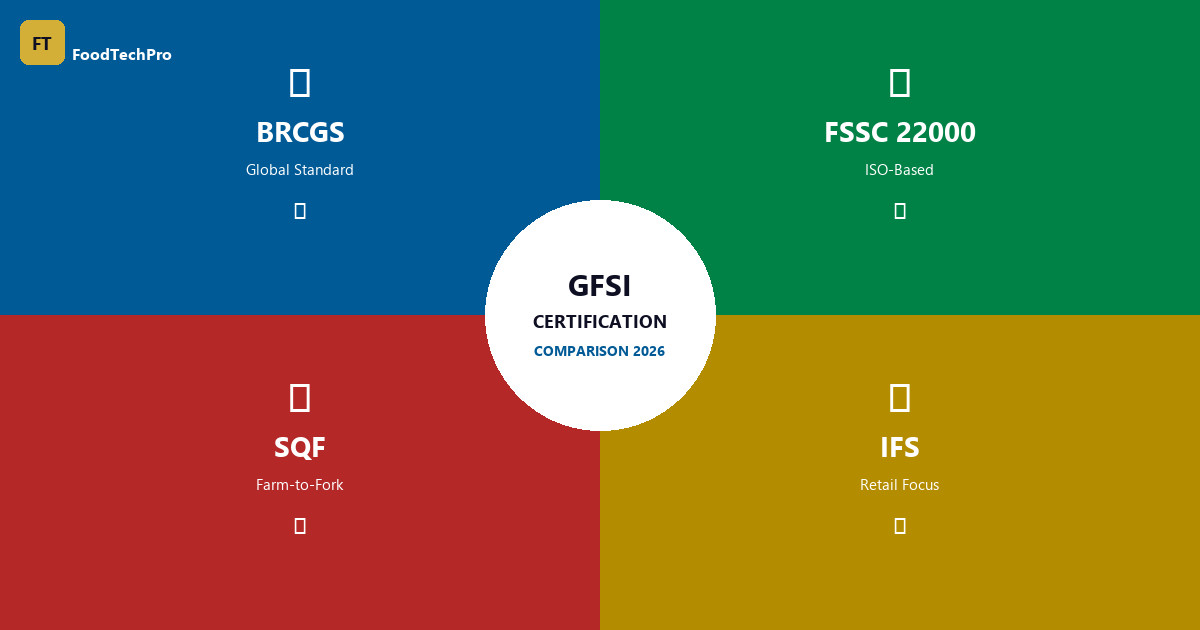
As of 2026, there are four major GFSI-recognised certification schemes that dominate the global food supply chain:
- FSSC 22000 — Food Safety System Certification (Netherlands-based)
- BRCGS — Brand Reputation through Compliance Global Standard (UK-based)
- SQF — Safe Quality Food Institute (USA-based)
- IFS — International Featured Standards (Germany/France-based)
Each scheme has its strengths, regional strongholds, and ideal use cases. Choosing the right one depends on your target markets, product categories, customer requirements, and existing management systems.
GFSI Certification Schemes — Detailed Comparison
| Feature | FSSC 22000 | BRCGS | SQF | IFS |
|---|---|---|---|---|
| Founded | 2009 | 1998 (as BRC) | 1994 | 2002 |
| Governing Body | Foundation for Food Safety Certification (Netherlands) | BRCGS (UK) | Food Marketing Institute / FMI (USA) | IFS Management GmbH (Germany) |
| Management System Approach | ISO-based (PDCA cycle) | Standard-based (own structure) | Standard-based (own structure) | Standard-based (own structure) |
| Audit Duration | 2–5 days (depends on size) | 1–3 days | 1–3 days | 1–3 days |
| Certification Cycle | 3 years + annual surveillance | 1 year (annual) | 1 year (annual) | 1 year (annual) |
| Unannounced Audits | Optional (announcement window) | Required (at least 1 every 3 years) | Optional | Announced only |
| Sector Coverage | Food, packaging, feed, catering, transport, retail/broker | Food, packaging, storage & distribution, agents/brokers, retail | Food, primary production, food packaging, warehouses | Food, logistics, packaging, brokers, retail/wholesale |
| Food Fraud (VACCP) | ✅ Included | ✅ Included | ✅ Included | ✅ Included |
| Food Defence (TACCP) | ✅ Included | ✅ Included | ✅ Included | ✅ Included |
| Food Safety Culture | ✅ Version 6 requirement | ✅ Issue 9 requirement | ✅ Edition 9 requirement | ✅ Version 8 requirement |
| Certified Sites (approx) | 30,000+ | 23,000+ | 10,000+ | 20,000+ |
| Primary Region | Global / Europe / Asia | UK / Europe / Middle East | North America / Australia | Europe / Germany / France |
| Best For | ISO users, exporters to EU/Asia | UK retailers, food manufacturers | North American food supply chain | European retail and brand owners |
FSSC 22000 — The ISO-Based Standard
FSSC 22000 is built on the ISO 22000:2018 food safety management system framework, combined with sector-specific prerequisite programmes (PRPs) and additional requirements. Its ISO heritage makes it the most natural choice for organisations already using ISO management systems (ISO 9001, ISO 14001, ISO 45001). The PDCA (Plan-Do-Check-Act) cycle is embedded in its structure, making integration with existing management systems straightforward.
Strengths: ISO compatibility, broad sector coverage, strong in EU and Asian markets, 3-year certification cycle reduces audit burden
Weaknesses: Less established in North America, documentation-heavy compared to BRCGS/SQF
Best fit: Export-oriented food manufacturers, food packaging companies, ISO-compliant organisations
BRCGS — The Global Standard
BRCGS (formerly British Retail Consortium Global Standard) is one of the oldest and most widely recognised GFSI standards. Its Issue 9 was published in 2022 and is the current version. BRCGS is known for its rigorous audit protocols, including mandatory unannounced audits for high-risk sites. The standard uses a structured, clause-based format with clear scoring guidelines (AA, A, B, C, D grades).
Strengths: Strong UK retailer acceptance, unannounced audit credibility, clear grading system, well-established globally
Weaknesses: Higher audit frequency (annual), stricter grading can make recertification challenging, less ISO-integrated
Best fit: UK-focused food exporters, suppliers to major British retailers, food manufacturing companies
SQF — The North American Leader
SQF (Safe Quality Food) is administered by the Food Marketing Institute (FMI) and is the dominant GFSI scheme in the United States and Canada. Its Edition 9 is the current version. SQF is unique in offering three certification levels, allowing businesses to progress from basic food safety to full HACCP-based systems. SQF provides dedicated codes for different food chain sectors.
Strengths: Strongest in North America, tiered approach (Level 1-3) for progressive implementation, clear food safety and quality distinction
Weaknesses: Less recognised outside North America and Australia, annual recertification, higher cost in non-US markets
Best fit: North American food supply chain, companies exporting to USA/Canada, retail food businesses
IFS — The European Retail Standard
IFS (International Featured Standards) is widely used across continental Europe, particularly in Germany, France, Italy, and Spain. IFS Food Version 8 is the current standard. IFS places strong emphasis on product quality alongside food safety. It is particularly common in private-label (own-brand) manufacturing for European retailers.
Strengths: Deep European retail penetration, strong quality focus, clear audit methodology, growing acceptance globally
Weaknesses: Limited recognition outside Europe, annual recertification, less common in Asia and Americas
Best fit: European private-label manufacturers, suppliers to German/French retailers, EU food exporters
How to Choose the Right GFSI Scheme
| If Your Target Market Is… | Recommended Scheme | Why |
|---|---|---|
| United Kingdom | BRCGS | Required by all major UK retailers (Tesco, Sainsbury’s, Asda, Morrisons) |
| United States / Canada | SQF or BRCGS | SQF is most recognised; BRCGS also accepted by major US retailers |
| European Union (continental) | IFS or FSSC 22000 | IFS for private label/retail; FSSC for ISO-based manufacturers |
| Middle East / Gulf States | FSSC 22000 or BRCGS | Both widely accepted; BRCGS preferred by some Gulf retailers |
| Southeast Asia / India | FSSC 22000 | Most established in Asian markets; ISO compatibility suits Asian manufacturers |
| Japan / South Korea | FSSC 22000 | ISO-based approach aligns with Japanese quality culture |
| Multiple global markets | FSSC 22000 or BRCGS | Both have widest global recognition across retailers and geographies |
Cost Comparison of GFSI Certification Schemes
| Cost Component | FSSC 22000 | BRCGS | SQF | IFS |
|---|---|---|---|---|
| Registration / Application Fee | $500–$1,000 | $300–$800 | $1,200–$2,500* | $500–$1,200 |
| Stage 1 Audit | $1,500–$3,000 | Combined with Stage 2 | Combined (one stage) | Combined with Stage 2 |
| Stage 2 Audit (small company) | $4,000–$7,000 | $5,000–$9,000 | $4,000–$8,000 | $4,000–$8,000 |
| Annual Surveillance | $2,000–$4,000 | Full re-certification (annual) | Full re-certification (annual) | Full re-certification (annual) |
| 5-Year Total (approx) | $15,000–$30,000 | $25,000–$55,000 | $22,000–$48,000 | $20,000–$45,000 |
* SQF requires an annual site registration fee paid to FMI. Costs vary significantly by certification body and region. India-based certification is typically 40–60% lower.
Frequently Asked Questions
Which GFSI scheme is the easiest to achieve?
There is no universally “easiest” GFSI scheme. The easiest depends on your existing systems. Organisations already using ISO management systems find FSSC 22000 most natural. Companies with strong HACCP-based systems adapt well to BRCGS and SQF. IFS is considered slightly less prescriptive than BRCGS by some auditors. In general, businesses new to certification find FSSC 22000’s ISO framework provides clearer implementation guidance.
Can I hold multiple GFSI certifications?
Yes, many organisations hold multiple GFSI certifications to satisfy different customer requirements. However, this is costly and resource-intensive. Most businesses choose the single scheme that best suits their primary market. Some certification bodies offer “combined audits” that assess against multiple schemes simultaneously, reducing duplication.
How long does GFSI certification take?
Most organisations achieve GFSI certification within 6 to 12 months. The timeline depends on your starting point: companies with existing HACCP or ISO 22000 systems may certify in 3 to 6 months, while those building a food safety system from scratch typically need 9 to 12 months. Key factors affecting timeline include management commitment, available resources, and the complexity of your food processes.
Is GFSI certification mandatory?
GFSI certification is not required by law in most countries. However, it is effectively mandatory if you supply food to major retailers or food service companies. Most global retailers require suppliers to hold GFSI-benchmarked certification as a contractual condition. In some jurisdictions, regulators may accept GFSI certification as evidence of compliance with food safety regulations, reducing inspection frequency.
Can I switch between GFSI schemes?
Yes, switching between GFSI-recognised schemes is common. When switching, the new certification body reviews your existing system against the target standard’s requirements. Some gap analysis and additional implementation work is usually needed, but the transition can often be completed within 3 to 6 months. Your current certification should remain valid during the transition period.
Which GFSI scheme is best for Indian food exporters?
For Indian food exporters, FSSC 22000 is generally the most suitable choice. Its ISO-based framework aligns well with Indian manufacturing practices, it offers broad global recognition (particularly in EU and Asian markets), and its 3-year certification cycle reduces long-term costs. However, if you are specifically targeting UK or North American markets, BRCGS or SQF may be more appropriate. Many Indian exporters serving multiple markets obtain FSSC 22000 as their primary certification.
Related Resources on FoodTechPro
For a detailed deep-dive into FSSC 22000, see our complete guide: FSSC 22000 Certification: Complete Global Guide. To understand the ISO 22000 foundation, read our ISO 22000:2018 Certification Guide. For businesses starting their food safety journey, our Food Safety Audit Checklist provides practical preparation steps. Also see our HACCP vs ISO 22000 vs FSSC 22000 comparison for India-specific guidance.
Conclusion
Choosing the right GFSI certification scheme is one of the most important strategic decisions a food business can make. The four major schemes — FSSC 22000, BRCGS, SQF, and IFS — each offer distinct advantages depending on your target markets, product categories, and existing management systems. The global food market, valued at over $9.67 trillion in 2026, increasingly demands GFSI certification as a prerequisite for supply chain participation.
For businesses targeting multiple international markets, FSSC 22000 offers the broadest global acceptance combined with the flexibility of ISO-based management. For UK-focused exporters, BRCGS remains the gold standard. North American markets favour SQF, while continental Europe predominantly uses IFS. Your certification choice should align with your market strategy today — and where you plan to expand tomorrow.

Prashant Chavhan
Prashant Chavhan is a food technologist and industry consultant based in India, specializing in FSSAI compliance, food safety management systems (HACCP/ISO 22000), and food processing business setup. With years of hands-on experience in the Indian food industry, he founded FoodTechPro.co.in to bridge the gap between regulatory requirements and practical implementation for food entrepreneurs and professionals.