What is the FDA FSMA 204 Traceability Rule?
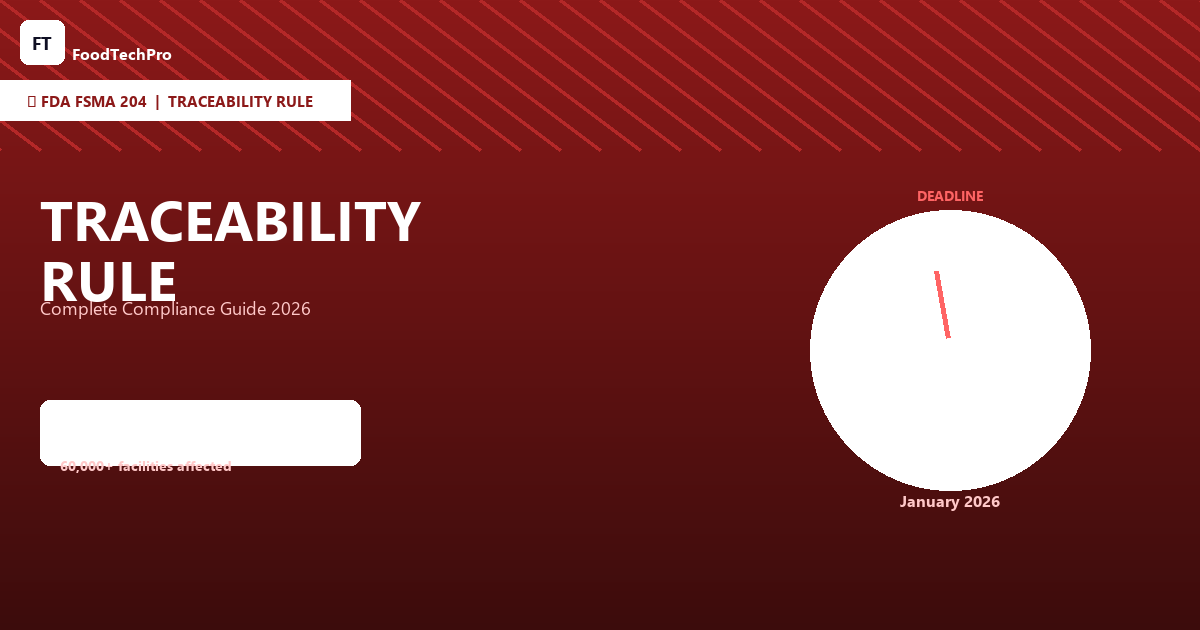
The FDA FSMA 204 Traceability Rule — formally titled “Requirements for Additional Traceability Records for Certain Foods” — is a landmark regulation under the U.S. Food Safety Modernization Act (FSMA). Published as a final rule by the U.S. Food and Drug Administration (FDA) in November 2022, FSMA 204 establishes uniform traceability recordkeeping requirements for persons who manufacture, process, pack, or hold foods on the Food Traceability List (FTL).
As of 2026, the rule is now in full enforcement. It represents the most significant expansion of food traceability requirements in U.S. history and has far-reaching implications for any company that grows, processes, or ships food into the United States — including thousands of food exporters from India, Latin America, Europe, and Southeast Asia.
The core objective: enable rapid identification and removal of potentially contaminated food from the market by creating a standardised, electronic trail of key data elements (KDEs) at critical tracking events (CTEs) throughout the food supply chain.
Which Foods Are Covered? (The Food Traceability List)
The rule applies to foods on the FDA’s Food Traceability List (FTL), which includes foods historically associated with foodborne illness outbreaks:
| Food Category | Examples |
|---|---|
| Cheeses (soft, semi-soft) | Feta, brie, camembert, queso fresco, fresh mozzarella |
| Shell eggs | Fresh eggs (not processed egg products regulated by USDA) |
| Nut butters | Peanut butter, almond butter, tahini |
| Cucumbers | Fresh cucumbers (all varieties) |
| Fresh herbs | Cilantro, basil, parsley, mint |
| Leafy greens | Lettuce, spinach, kale, chard, collard greens |
| Melons | Cantaloupe, watermelon, honeydew |
| Peppers | Bell peppers, chilli peppers, jalapeños |
| Fresh-cut fruits & vegetables | Pre-cut salad mixes, fruit cups, chopped vegetables |
| Finfish (including smoked) | Salmon, tuna, mackerel, cod, tilapia |
| Frozen fruits & vegetables | Frozen berries, frozen corn, frozen mixed vegetables |
| Tropical tree fruits | Mangoes, papayas, avocados, coconuts |
| Ready-to-eat deli salads | Egg salad, chicken salad, potato salad |
| Shellfish (molluscan) | Oysters, clams, mussels, scallops |
| Tomatoes (fresh) | Fresh tomatoes (not canned) |
The list is subject to periodic updates by the FDA as new outbreak data emerges.
Key Requirements of FSMA 204
Critical Tracking Events (CTEs)
Companies must maintain records at each of these CTEs:
- Receiving — When food is received from a supplier
- Transforming — When food is processed/transformed (cooking, cutting, combining, repackaging)
- Shipping — When food is shipped to a customer
- Creating — Initial point of entry into the U.S. supply chain (importer, domestic grower)
- Cold chain — Temperature-controlled storage or transport events
- Bulk transport — Bulk shipments between facilities
- Consumer-facing — Last facility before retail or food service (where applicable)
Key Data Elements (KDEs)
For each CTE, companies must record and maintain specific KDEs:
- Farm or grower location identifier (GLN or FDA-assigned)
- Lot/batch number
- Product description and quantity
- Date received, transformed, or shipped
- Location identifiers for all facilities (receiving, shipping, transforming)
- Reference record type (internal or supplier-assigned traceability codes)
- Traceability lot code (can be existing lot code or new TLC)
- Temperature data (for cold chain CTEs)
Record Retention and Availability
- Records must be maintained for 2 years (or 6 months for certain foods with shorter shelf life)
- Records must be made available to FDA within 24 hours (or 4 hours if requested during normal business hours) of an FDA request during a foodborne illness investigation
- Electronic records are acceptable and encouraged — paper records are also permitted
- Records must be sortable and searchable by at least one KDE
Who Must Comply?
Any person or organisation that manufactures, processes, packs, transports, stores, holds, or imports food on the FTL — and is not exempt — must comply. This includes:
- U.S. domestic food manufacturers and processors
- Importers bringing FTL foods into the United States
- Foreign food exporters shipping FTL foods to the U.S.
- Distributors and warehouses handling FTL foods
- Cold storage and logistics providers for FTL foods
- Retail food establishments and restaurants (with some exemptions)
Exemptions
- Farms (except where food is packaged or transformed off-farm)
- Restaurants — defined as facilities that prepare and serve food directly to consumers
- Retail food establishments — grocery stores, convenience stores, supermarkets
- Very small businesses (average annual sales below $25,000 and limited production)
- Foods subject to HACCP — seafood (under FDA’s seafood HACCP) and juice (under juice HACCP)
- USDA-regulated products — meat, poultry, processed egg products
Technology Requirements and Traceability Software
While FSMA 204 does not mandate any specific technology, the requirement to make records available electronically within hours during an outbreak means that most companies will need a digital traceability solution:
| Solution Type | Examples | Typical Cost (Annual) |
|---|---|---|
| ERP-integrated traceability | SAP, Oracle, Microsoft Dynamics traceability modules | $10,000–$100,000+ |
| Specialised traceability software | FoodLogiQ, iFoodDS, ReposiTrak, TraceGains, Rfxcel | $5,000–$50,000 |
| GS1 EPCIS-based platforms | GS1 US Traceability Solution, 1WorldSync | $3,000–$25,000 |
| Blockchain traceability | IBM Food Trust, TE-FOOD, OriginTrail | $2,000–$30,000 |
| Paper-based / spreadsheet | Manual records (limited compliance risk) | Minimal but high labour cost |
GS1 Standards — The FDA has heavily endorsed GS1 standards for FSMA 204 compliance. GS1 Global Location Numbers (GLNs) for facilities and GS1-128 barcodes for lot-level tracking are widely considered the industry standard approach.
Compliance Deadlines and Enforcement (2026 Status)
- November 2022 — Final rule published
- January 2026 — Compliance date passed for most businesses
- 2026 onwards — FDA actively enforcing through routine inspections and outbreak investigations
- Penalties — Non-compliance can result in FDA warning letters, import alerts (detention without physical examination), seizure, and injunctions
The FDA’s Human Foods Program has identified traceability compliance as one of its top 2026 priority deliverables, signalling strong enforcement intent.
FSMA 204 vs Other Global Traceability Regulations
| Feature | FSMA 204 (USA) | EU Food Traceability | FSSAI Traceability (India) |
|---|---|---|---|
| Key Legislation | FSMA Section 204 | EU Regulation 178/2002 (General Food Law) | FSS (Food Safety Standards) Regulations |
| Scope | FTL foods only | All foods and feed | All food businesses (phased) |
| Key Data Required | KDEs at CTEs (detailed, standardised) | One step back, one step forward | Batch/lot records, supplier-customer linkage |
| Response Time | 24 hours (4 hours urgent) | Reasonable time | As specified by FSSAI |
| Technology Mandate | None specific (electronic encouraged) | None specific | Digital records encouraged |
| Record Retention | 2 years (6 months for short shelf-life) | 5 years | As specified by FSSAI |
| Enforcement | High (2026 priority) | Moderate to high | Growing (digital push) |
How to Prepare for FSMA 204 Compliance
- Determine applicability — Check if your products are on the FTL
- Identify CTEs — Map your supply chain to identify all critical tracking events
- Assign traceability lot codes — Establish a consistent TLC system (GS1-128 recommended)
- Adopt GS1 GLNs — Assign Global Location Numbers to all facilities
- Select traceability software — Evaluate and implement a digital traceability solution
- Train staff — Ensure all personnel understand recordkeeping requirements
- Test your system — Conduct mock recall exercises to validate 24-hour response
- Audit suppliers — Verify that your upstream suppliers maintain compliant traceability records
- Document everything — Maintain your traceability plan, procedures, and training records
Frequently Asked Questions
Does FSMA 204 apply to foreign food exporters?
Yes. Any foreign facility that manufactures, processes, packs, or holds food on the Food Traceability List and exports it to the United States must comply with FSMA 204. The foreign facility must establish and maintain traceability records and make them available to the FDA within 24 hours upon request. This is enforced through the FDA’s foreign facility inspection programme and import screening.
What are the penalties for non-compliance?
Penalties for FSMA 204 non-compliance may include FDA warning letters, import alerts (detention without physical examination), administrative detention, seizure of products, and injunctions. In serious cases involving repeated violations, civil money penalties and even criminal prosecution are possible. In 2026, the FDA has made traceability compliance a top priority for its Human Foods Program.
How is FSMA 204 different from existing FDA traceability requirements?
FSMA 204 is far more prescriptive than existing FDA traceability requirements. While previous regulations required “one step back, one step forward” traceability, FSMA 204 mandates specific Key Data Elements (KDEs) at specific Critical Tracking Events (CTEs) throughout the supply chain. It also requires records to be available for electronic sorting within 24 hours — a significant acceleration from previous response expectations.
Does the rule apply to imported food from India?
Yes. Indian food exporters shipping FTL-covered foods (such as mangoes, frozen shrimp, leafy greens, spices, fresh herbs, and frozen vegetables) to the United States must comply with FSMA 204. The Indian exporter and the U.S. importer share compliance responsibility. Many Indian food exporters are now working with traceability software providers and GS1 India to implement compliant systems. Indian mango exports, frozen shrimp, and processed vegetable exports to the U.S. are directly affected.
What technology is best for FSMA 204 compliance?
The FDA recommends a risk-based approach to technology selection. GS1 standards (GLNs for locations, GTINs for products, EPCIS for event data) are widely considered best practice. Specialised traceability platforms like FoodLogiQ, ReposiTrak, and TraceGains offer FSMA 204-specific compliance modules. ERP-based solutions (SAP, Microsoft Dynamics) can also work with proper configuration. The key requirement is the ability to retrieve and share records electronically within 24 hours.
Related Resources on FoodTechPro
For a comprehensive overview of India’s food regulatory framework, see our FSSAI License Complete Guide 2026. Understanding your domestic regulatory requirements is essential before tackling international compliance.
If you are setting up a food export business, our How to Start a Food Processing Business in India guide covers licensing, facility requirements, and compliance fundamentals. For detailed cost planning, see Food Processing Plant Setup Cost India 2026.
To understand food safety management systems relevant to both domestic and export markets, read our comparison: HACCP vs ISO 22000 vs FSSC 22000 Comparison and our Food Safety Audit Checklist.
For market context and industry trends that drive international food trade, visit Food Industry Statistics India 2026 and Food Industry Trends 2026.
Conclusion
The FDA FSMA 204 Traceability Rule represents a fundamental shift in how the U.S. food safety system approaches traceability. For food businesses — both domestic and international — compliance is no longer optional. With the compliance date now passed and enforcement ramping up in 2026, every company handling foods on the Food Traceability List must have a fully implemented traceability system that can deliver records within hours, not days.
Practical Steps for Indian Food Exporters to Comply with FSMA 204
Indian food exporters shipping FTL-covered products to the United States should take the following concrete steps to achieve compliance:
- Register with GS1 India — Obtain Global Location Numbers (GLNs) for your facility and any warehouses or cold storage locations. GS1 standards are the most widely accepted identifier system for FSMA 204 compliance.
- Implement traceability lot codes — Assign lot/batch numbers to all production runs using a consistent format. GS1-128 barcode encoding is recommended for global supply chain compatibility.
- Digitalise your records — Transition from paper-based traceability to an electronic system. Even a spreadsheet-based system is preferable to paper records for meeting the 24-hour FDA response requirement.
- Train your quality team — Ensure your food safety and quality assurance teams understand the specific KDE and CTE requirements for each product category you export.
- Coordinate with your U.S. importer — FSMA 204 compliance is a shared responsibility. Your U.S. importer of record must also maintain traceability records linking your shipments to their distribution chain.
- Conduct a mock recall — Test your system by simulating an FDA request for traceability records. Can you identify and present all KDEs for a specific lot within 4 hours? If not, you need to improve your system.
- Review FDA import alerts — Stay informed about FDA import alerts relevant to your product category. Products from facilities with previous compliance issues face heightened scrutiny.
The FDA’s Foreign Supplier Verification Programs (FSVP) rule already requires importers to verify that foreign suppliers meet U.S. food safety standards. FSMA 204 adds a parallel traceability requirement that affects both the foreign supplier and the U.S. importer. Together, these rules create a comprehensive compliance framework for imported food products.
For Indian food exporters and food businesses around the world, FSMA 204 compliance is an investment in market access. Companies that implement robust traceability systems will not only meet FDA requirements but also build competitive advantage through visible food safety commitments that global buyers increasingly demand.

Prashant Chavhan
Prashant Chavhan is a food technologist and industry consultant based in India, specializing in FSSAI compliance, food safety management systems (HACCP/ISO 22000), and food processing business setup. With years of hands-on experience in the Indian food industry, he founded FoodTechPro.co.in to bridge the gap between regulatory requirements and practical implementation for food entrepreneurs and professionals.